Emergency Garage Door Repair Near Me: What Lakeland Homeowners Should Do First
When a garage door fails in Lakeland, the first fifteen minutes decide whether you’re dealing with a contained problem or a cascading one. A door that won’t open is an inconvenience. A door that won’t close, or is hanging mid-travel on a broken spring, is a security and liability risk that needs a specific sequence of actions before anyone touches the opener button again. If you’d rather skip the assessment and get a specialist on the line, call (866) 253-2286.
The First Five Minutes: Stabilize Before You Diagnose
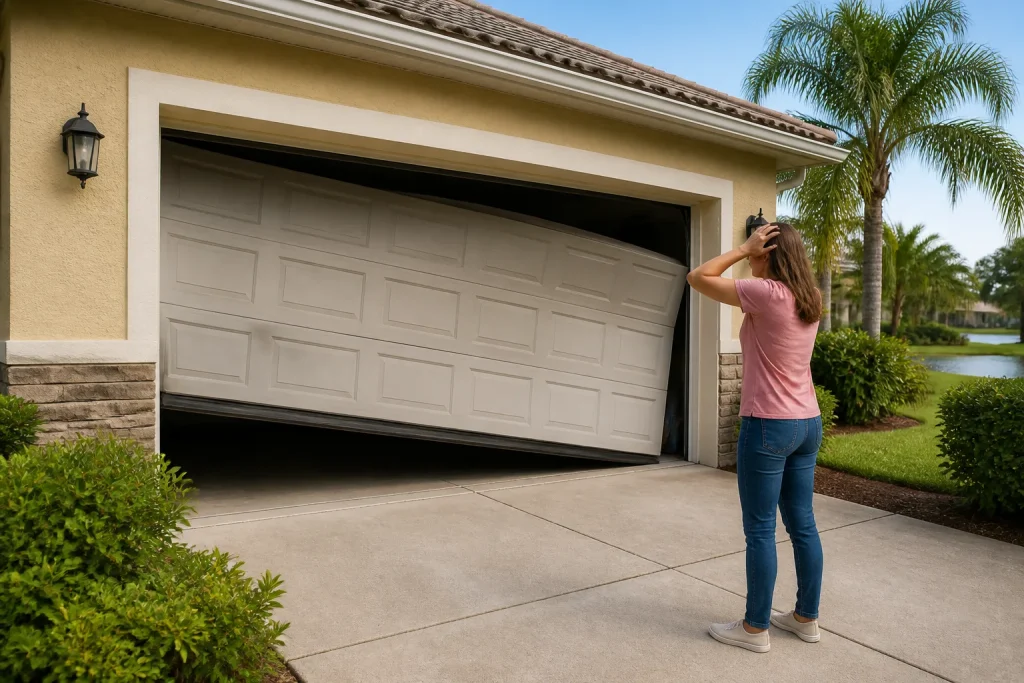
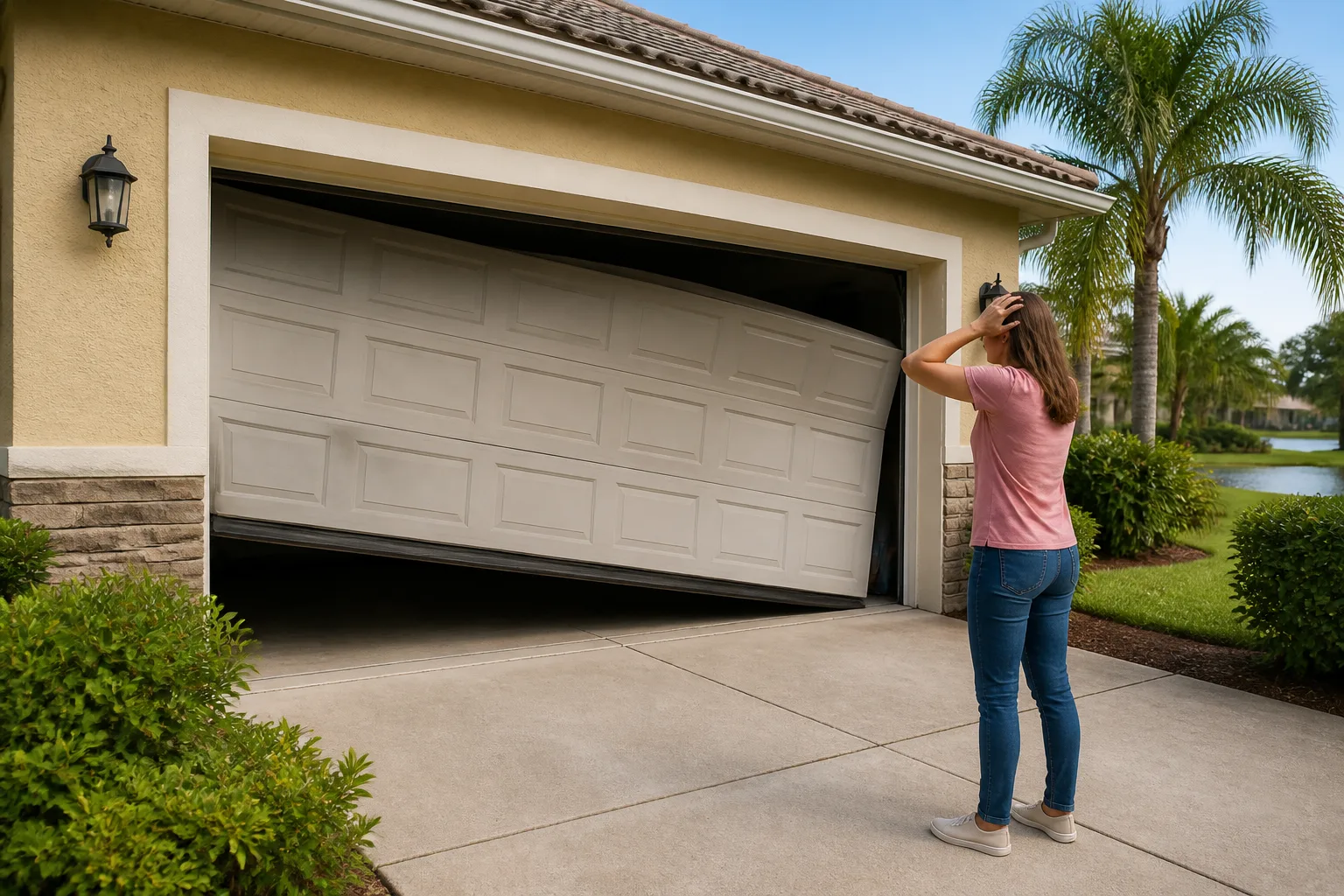
The instinct when a garage door stops working is to press the opener button again. Resist that instinct. A garage door held up by a single broken spring and a straining opener cable is not “stuck” – it’s a 400-pound panel in an unstable load state. Triggering the opener again is the fastest way to snap the cable and drop the door onto whatever happens to be underneath it.
Here’s the three-step stabilization sequence we walk Lakeland homeowners through on the phone:
- Disengage the opener. Pull the red emergency release cord hanging from the opener rail. This separates the door from the motor. If the door is mid-travel when you do this, it may lurch – stand to the side, never directly under the door.
- Do not attempt to manually lift a spring-broken door. If a torsion spring has snapped, you’ll hear it – a loud bang that sounds like a firecracker going off in the garage. The door will feel impossibly heavy because the spring system counterbalances the full panel weight. Without that counterbalance, you’re lifting 130 to 400 pounds dead. You will not win that fight, and the door can slam down harder than you expect.
- If the door is mid-travel, prop or clamp safely. Slide a sturdy stepladder or a pair of locking pliers (vise grips) onto the track just below the bottom roller on each side. This keeps the door from dropping further while you assess. Never use a broom handle, a loose board, or anything that can slide or snap.
In Lakeland’s humid climate, we see a specific pattern with stabilization failures: rusted track hardware and swollen wooden door frames mean a door that shifts sideways before it drops. The propping step matters more here than in dryer climates because tracks that have been quietly corroding for years give way unevenly.
Won’t Close vs. Won’t Open: Two Different Emergency Profiles
All garage door failures are not the same emergency. The direction of the failure changes what you should do in the first hour.
A door that won’t close is a security problem. Your home is now open to the street, the alley, or the neighbor’s security camera. In Lakeland, where garage doors face alleys in older neighborhoods like Dixieland and Lake Hollingsworth’s historic district, an open door after dark is a visible invitation. The priority shifts from mechanical diagnosis to physical security. You need the door secured in the down position, even if that means manually lowering a door that’s still on intact springs, or blocking and covering an opening that can’t be closed.
A door that won’t open is a logistics problem. Vehicles are trapped, which in Lakeland means you can’t get to work in Orlando, can’t get to school drop-off, can’t run the boat to the ramp at Lake Parker. But the house is still secure. The door is down. The mechanical failure is contained. This is an emergency for your schedule, not for your safety – and the immediate actions are different. You’re not racing to block an opening. You’re assessing whether the failure is a spring, a cable, an opener, or a track issue before calling a repair service.
The distinction matters because it determines what you tell the technician when you call. A door that won’t close needs someone who prioritizes security stabilization. A door that won’t open needs someone who gets the right parts loaded. Both scenarios start with the same call: (866) 253-2286.
What to Say When You Call: The Details That Get the Right Tech on the First Visit
Every garage door repair company in Lakeland asks the same opening question: “What’s going on with the door?” And most homeowners give the same answer: “It’s broken.” That answer is honest and also useless. Here’s what actually helps the dispatcher send a properly equipped technician on the first visit.
Tell them the brand. If the opener is a Genie or the door is a Wayne Dalton or Clopay, say it. Wayne Dalton doors use a proprietary TorqueMaster spring system that sits inside the tube, not exposed on the bar above the door. That’s a different set of tools and parts than a standard torsion setup. Knowing the brand before dispatch means the truck leaves stocked for your specific door, not for whatever door is most common.
Tell them the spring type. Look at the wall above your closed garage door. If there’s a long metal bar with two coiled springs wrapped around it, those are torsion springs. If there are two springs running along the horizontal tracks on each side of the door, those are extension springs. Torsion springs are the ones that fail with the firecracker bang. Extension springs fail more quietly but can send metal shards across the garage when they snap. Both are dangerous, and both are common on Lakeland homes built in the 1980s through early 2000s.
Tell them the symptom that triggered the failure. Did it make a loud bang and then stop? Did it start closing and then reverse for no reason? Did it strain partway up and halt? Did the opener run but the door didn’t move at all? Each symptom points to a different failure mode: snapped spring, misaligned safety sensor, broken cable, stripped gear inside the opener, or a door that’s jumped the track.
We work on the brand already on your door. That’s not a limitation – it’s the entire point. A technician who knows the specific quirks of an Amarr door with a Clopay retrofit opener isn’t guessing at the failure; they’re recognizing it.
After-Hours Reality in Lakeland: What Actually Needs a 3 a.m. Call
The phrase “emergency garage door repair near me” gets typed into phones across Lakeland at all hours. The reality is that most garage door failures don’t require a technician at 3 a.m. What they require is a homeowner who can secure the door and safely wait for a morning service window.
Legitimate after-hours dispatch: a door stuck in the open position that can’t be manually lowered, a door trapping a vehicle that’s needed for a medical emergency, a door that has dropped onto a car or workbench and needs immediate extraction, or a spring that snapped while the door was open and left the panels hanging dangerously. These are real emergencies. Call. We answer. (866) 253-2286.
Can safely wait until morning: a door that won’t open but is fully closed and secured, an opener that makes a grinding noise but the door stays in position, or a broken spring on a door that you’ve propped and clamped at the bottom of the track. Secure the door, stop using the opener, and call in the morning for the next available window. The repair won’t be worse at 8 a.m. than it was at 11 p.m.
We pulled one out of a garage over in the Lake Morton area last spring where the homeowner had tried to fix a broken extension spring with a come-along winch from a boat trailer. The door was at a 30-degree angle, one cable was wrapped around the spring hook, and the whole assembly was under tension. It took an hour just to safely release the load before any actual repair could start. The door would have been a simple morning spring replacement. The winch experiment turned it into a half-day job and a new track section. Don’t improvise with load-bearing hardware.
When to call a pro: if you’re looking at a spring of any kind, a cable that’s off the drum, or a door off its track, call. These are not diagnostic puzzles – they’re tension and weight problems that can injure you faster than you can react. Garage doors are all we do, and the reason we carry that focus is because these systems fail in specific, predictable ways that reward specialized knowledge and punish guesswork.
Temporary Security When the Door Is Stuck Open
If the door fails in the open position and you’re waiting for service, your house is exposed. Here’s the sequence for temporary security that doesn’t make the mechanical problem worse.
First, stop using the opener remote entirely. Put it somewhere you won’t reflexively grab it. Every accidental activation sends the opener motor straining against a door that can’t move, and a burned-out opener motor turns a $250 spring replacement into a multi-hundred-dollar repair that includes a new opener head. If the door is off its track, an opener activation can bend hinges and snap the top panel.
Second, manually lock the door in place if possible. Most garage doors have a manual slide lock on the interior track – a metal bar that slides into a slot in the vertical track. Engage it if the door is down and the lock still lines up. If the door is stuck open, that lock won’t help. Instead, clamp locking pliers onto the vertical track directly below the bottom roller on both sides. This keeps the door from drifting down onto a vehicle or person, and it signals to anyone approaching that the door isn’t moving on its own.
Third, secure the opening itself. If the door is stuck halfway or in the full open position, block the gap. Hang a tarp, move tools and valuables out of sight, and lock the interior door that connects the garage to the house. In Lakeland’s older neighborhoods, especially around South Lake Morton and Beacon Hill, the garage-to-house door is often an original hollow-core door with a privacy lock. That’s not real security against someone who’s already inside the garage. A deadbolt or a security bar matters here.
From the cable to the connected opener, the whole system has one job: keep a heavy steel and wood panel moving safely up and down on demand. When one component fails, it loads the others. The temporary steps above are about stopping that cascade until the right parts and the right knowledge show up.
The Bottom Line
A garage door emergency in Lakeland follows a clear sequence: stabilize, assess, secure, then call. Stabilize by disengaging the opener and propping a mid-travel door. Assess by figuring out whether you’ve got a security problem or a logistics problem, and know which spring type you’re looking at. Secure by stopping all opener use and locking or clamping the door in place. Then call with the brand, the spring type, and the symptom so the truck arrives equipped for your door, not for a generic one.
If you’re in Lakeland and the door’s acting up, Lift Line Garage Door Repair offers free estimates. We service LiftMaster, Chamberlain, Genie, Clopay, Amarr, Wayne Dalton, Craftsman, and Raynor equipment – the brands already on American garage doors. Call (866) 253-2286. The sooner you call, the smaller the repair.
Related services in Lakeland: Garage Door Repair in Jan-Phyl Village, Garage Door Opener Repair in Jan-Phyl Village, and Garage Door Installation in Jan-Phyl Village. Lift Line Garage Door Repair home.
Frequently Asked Questions
No. A door stuck mid-travel is under uneven load. Pull the emergency release cord to disengage the opener, do not attempt to lift the door manually, and clamp locking pliers onto both vertical tracks below the rollers. A stuck mid-travel door is one of the few garage door emergencies that justifies an immediate call. Call (866) 253-2286 for guidance while you wait.
Look at the torsion bar above the closed door – if one of the two coiled springs has a visible gap in the coil, it’s broken. You’ll typically hear a loud bang when it fails. If the door feels extremely heavy when you try to lift it manually (after disengaging the opener), the spring’s counterbalance is gone. This is not a DIY repair. Torsion springs are under extreme tension and require specialized winding tools and technique.
Yes. If the door is fully up and stuck, clamp locking pliers on the vertical tracks below the bottom rollers on both sides. Lock the garage-to-house interior door, remove valuables from view, and do not use the opener until a technician inspects it. If the door is partially down, prop the opening with a solid object that can’t slide or snap.
Broken torsion springs are the most common cause on Lakeland homes, driven by a combination of age and the humidity-related corrosion that builds up on spring coils over time. Springs are rated for a specific number of cycles – typically 10,000 – and most homes hit that limit in 7 to 12 years. The humidity we deal with in Florida accelerates surface corrosion, which can shorten spring life on doors that get used multiple times daily.
Not at Lift Line. The price is quoted and agreed upon before any work starts. We diagnose the failure, explain what we found, tell you the cost, and get your approval before turning a wrench. If the diagnosis reveals additional damage beyond the initial problem, we show you and get a second approval before moving forward. Free estimates: (866) 253-2286.
Written by the team at Lift Line Garage Door Repair, serving Lakeland since 2012.
Need Garage Door Help?
Call Lift Line Garage Door Repair — licensed & insured, here with fast after-hours help in Lakeland.
(866) 253-2286